
DMO – Destination Marketing or Management Organization?
Giving relevant destination stakeholders greater visibility, building resilient networks and connecting their narratives can be part of destination management, even when achieved through marketing activities.
In my dissertation From Campfires to Social Media we investigated how different storytelling styles influence audience engagement and which factors strengthen or weaken it.
But how do we make sense?
Humans have always used stories to make sense of the world. For thousands of years, people have gathered around campfires to share knowledge, experiences, identity and even survival tactics. Walter R. Fisher described this idea through the Narrative Paradigm in 1984: humans are, in a sense, homo narrans, we understand the world through stories.
Today, social media can be seen as the new campfires. There are fast, accessible spaces where people continuously share and interpret stories.
For destinations, this means that multiple narratives can exist simultaneously around the same place. People create meaning through their own experiences and perspectives, while residents, visitors, artists, tourists and DMOs may each contribute different stories to the destination.
A DMO therefore cannot fully control a place narrative. When working with a place brand, the DMO’s role is to understand the narratives already shaping the destination and identify the shared meanings that connect them. In practice, this means looking at who is telling these stories, which perspectives they represent and where their narratives overlap.
How do people experience Digital Storytelling?
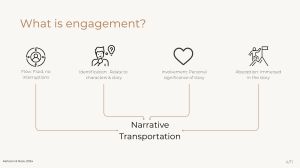
Narrative Transportation Theory (NTT) provides a useful way to understand how audiences engage with a story through four connected components:
Flow describes how easily a narrative can be followed and understood, supported by clear structures and a coherent relationship between visuals and audio.
Identification describes whether people recognise themselves, their emotions or their own experiences in the story. Shared struggles, perspectives or identities can make a narrative feel personally relevant.
Involvement refers to the personal relevance of the story and its connection to what the audience values and cares about. Shared interests and topics such as nature, belonging or cultural identity can strengthen this connection.
Absorption describes the point where the viewer becomes fully immersed in the narrative and focused on the story. In an online context, this can when someone stops scrolling and becomes engaged with the content.
These components can overlap. In practice, Flow and Absorption are particularly closely connected. A useful distinction is that Absorption draws people into a narrative, while Flow helps them stay with it. For destination development, this framework can be used when developing or evaluating digital storytelling. Who is the story for? What makes it personally relevant? And what helps the audience become immersed in it?
UGC vs. Serious Storytelling
Probably the most sterile character. The overcooked chicken of people. No salt, no pepper.
– Focus Group Participant
User Generated Content (UGC), which is content produced by anyone about a certain topic online, can either contribute to the co-creation of narrative engagement or be co-destructive to it. This applies to destinations as well, where UGC can contribute meaning and different perspectives to a place narrative.
In this study, however, UGC was primarily associated with digital trash. Content with little meaning or added value, often perceived as sterile and generic, with little emotional resonance or sense of authenticity.
By contrast, DMO-produced serious storytelling showed a strong ability to transport viewers directly into the story. Serious storytelling goes beyond pure entertainment. It reflects real and/or critical situations and aims to create emotional engagement. It is further characterised by clear goals, factual knowledge, intrinsic motivation, reflection, self-empowerment, inspiration and collective memory.
When selecting partners or creators, destinations should assess their shared values, perspectives and the contribution their content can make to the wider place narrative. Naturally this can also be applied when reviewing existing partnerships. Do the people and organisations representing the destination share the same values and perspectives that are relevant to the wider place narrative and their actors itself?
Maybe I felt jealous that the protagonist had found their purpose.
– Focus Group Participant
The big buzzword: Authenticity
UGC is often described as the answer to authentic (place) marketing. Multiple studies show that co-creation can and does add to value creation, but other reseach also shows that co-destructive patterns can emerge, as demonstrated in this study through UGC.
On social media, UGC can often be seen as algorithm-optimised content that frequently plays with clichés and superficial elements. Therefore, UGC can be helpful, but is not always the answer. Authenticity is not a format or a result of UGC itself. It comes from the meaning, relevance and connection that a narrative creates with its audience and the place it represents.
Destinations can build content around everyday experiences, local perspectives and ordinary moments which add a realistic dimension to destination communication and complement polished marketing materials.
What does that mean for you as a destination brand or place making entity?
1. Know who the narrative is for
A strong destination narrative starts with understanding the audience. Different people interpret the same place in different ways, based on their cultural background, experiences, interests and familiarity with the destination. The better you understand your audience, the more effectively you can create narratives that feel relevant and recognisable to them. Look at who is already shaping the destination narrative from the inside of “your destination” and how different audiences interpret their narrative.
2. Make the narrative easy to follow
Good storytelling needs clarity. Discrepancies between moving images, sound and narrative structure can interrupt the audience’s Flow and weaken engagement. A strong narrative should be clear, coherent and inclusive.
3. Not all content is engagement
Generic content, clichés and superficial storytelling can quickly become digital noise and weaken the meaning of a destination. The question is therefore not how much content a destination produces, but whether that content adds a coherent value. Review your content for the meaning it adds to the wider destination narrative.
4. Build emotional relevance
Relatability, emotional connection and personal relevance can draw audiences into a narrative and keep them there. Particularly through serious storytelling, destinations can create stronger connections by addressing real experiences, challenges, values and identities rather than relying only on attention-driven content.
The role of the DMO is therefore not to control a destination’s narrative, but to influence the conditions in which meaningful narratives can emerge. Moreover, identifying the narratives and values that connect different actors and reinforcing these across multiple channels can ultimately strengthen the destination’s perceived brand image. This creates a useful starting point for destination analysis: mapping the narratives already present, identifying shared values and perspectives, and strengthen them through your own resources in communication and partnerships.
Interested into the topic? Let’s talk Destinations!












Presentation on narrative engagement as an example
